+92 3218447030
aqua.hygienic@gmail.com
Get cleaner, better-managed water throughout your property with a whole house water filtration system designed around your water source, quality and daily requirements.
Aqua Hygienic provides whole house water treatment solutions for homes and properties where filtration is required at the main water supply rather than at a single tap. By treating water at the point of entry, the system can supply filtered water to multiple outlets across the property
A whole house water filter treats water as it enters the property, before it reaches individual taps, showers and connected water fixtures. This point-of-entry approach makes it different from an under-sink or countertop filter that serves only one location.
The right treatment setup depends on the incoming water. Sediment, hardness, chlorine, taste, odour and other water-quality concerns may require different treatment methods rather than a single universal filter.
Aqua Hygienic helps identify the appropriate filtration approach according to the water source, water-quality concerns, household demand and intended use.
A whole home water filtration system is normally installed on the main incoming water line. Water passes through the selected treatment stages before being distributed around the property.
The actual filtration process varies according to the water analysis and system configuration. One property may mainly require sediment filtration, while another may need activated carbon treatment, water softening or additional treatment.
This is why whole-house filtration should be selected according to the condition of the incoming water rather than simply by choosing the system with the greatest number of filtration stages.
Whole house filtration is not a single treatment technology. Different filtration and treatment methods address different water-quality concerns.
A sediment water filtration system is used to capture suspended particles such as sand, silt, rust and other visible matter before the water moves further through the treatment system.
Sediment pre-filtration can also help protect downstream filtration components from unnecessary particle loading.
A carbon water filtration system can be used where treatment is required for chlorine and certain taste or odour concerns.
The performance of activated carbon depends on the type of carbon, system design, water characteristics, flow rate and the contaminants being targeted.
Where hard water is a concern, water softening may be incorporated as a separate treatment stage.
Hardness is mainly associated with dissolved calcium and magnesium. These minerals can contribute to scale deposits on plumbing fixtures, pipes and water-heating equipment.
A water softener addresses hardness; it should not be treated as a replacement for filtration or disinfection where those forms of treatment are required.
Some water conditions may require treatment beyond sediment and carbon filtration. The appropriate solution should be determined by the actual water-quality issue and the intended use of the treated water.
Testing the source water first provides a more reliable basis for choosing a home water purification system than assuming that every property requires the same treatment process.
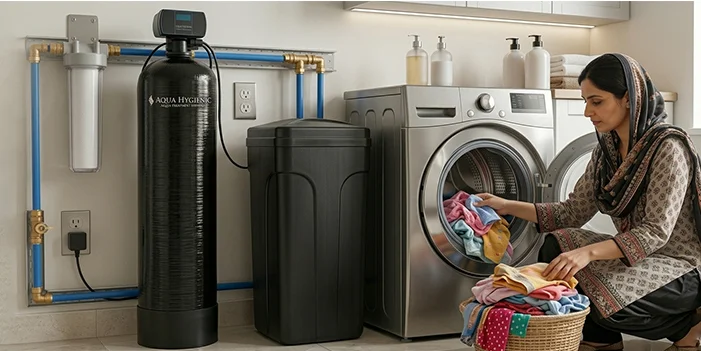
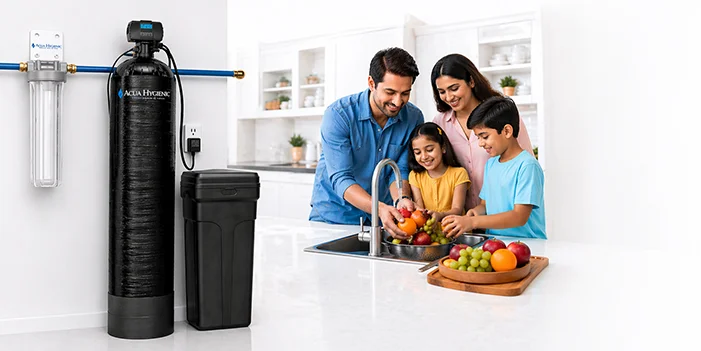
A centralized filtration system is useful when the water-quality concern affects more than drinking water at a single tap.
Treatment takes place near the main point of entry, allowing filtered water to be supplied to multiple outlets rather than treating each tap separately.
Where sediment is present in the incoming supply, appropriate pre-filtration can reduce suspended particles before the water enters household plumbing and fixtures.
When water analysis indicates excessive hardness, an appropriate softening stage can reduce the calcium and magnesium responsible for scale formation.
Activated carbon may be included where the objective is to address chlorine-related taste, odour or other contaminants for which the selected carbon media is suitable.
Instead of installing separate general-purpose filters at several locations, a complete home water filtration setup treats the incoming supply from a central point.
Whole-house filtration and drinking-water purification serve related but different purposes.
A whole-house or point-of-entry system treats water entering the property and is intended to improve water quality across multiple household outlets.
A point-of-use system treats water at a specific location, such as the kitchen sink. Depending on source-water quality and the treatment objective, a household may use whole-house filtration together with a dedicated drinking-water system.
For example, a property may use sediment and carbon filtration at the main inlet while using a Domestic RO System at the kitchen for additional drinking-water treatment.
The correct combination depends on the incoming water and the contaminants that need to be addressed.
A whole house water treatment system may be worth considering when:
Not every property requires the same system. Water source, water chemistry, household consumption, required flow and the intended use of the treated water all influence system selection.
Selecting a home water filtration system starts with understanding the water rather than choosing equipment first.
Municipal supply, bore water and other sources can present different treatment requirements.
Determine whether the main concern is sediment, hardness, chlorine, taste, odour or another specific water-quality issue.
Water testing is particularly important where the concern involves contaminants that cannot be identified reliably by appearance, smell or taste.
A whole-house system has to handle water used simultaneously at different outlets. System sizing therefore needs to consider expected flow and household demand.
Sediment filters, activated carbon, water softeners and other technologies perform different functions. Treatment stages should be selected for the specific problem they are intended to address.
Filters and treatment media do not work indefinitely. Replacement and servicing requirements vary by system, water quality and usage.
Regular maintenance is an important part of maintaining filtration performance.
Water conditions can vary considerably between properties and water sources, so there is no single residential water filtration system that is appropriate for every home.
For Pakistani homeowners, practical concerns may include visible sediment, hard water, chlorine-related taste or odour, variable source-water quality and the need to treat water at several outlets.
The useful question is therefore not simply, “Which whole house filter is best?” but rather, “What is present in my water, and which treatment stages are appropriate for it?”
Aqua Hygienic can help assess the filtration requirement and identify a suitable configuration based on the property’s water conditions and expected usage.
Aqua Hygienic provides water filtration and treatment solutions for residential, commercial and industrial applications.
For whole-house applications, the focus is on selecting treatment according to the property’s actual water requirements rather than applying one configuration to every installation.
Depending on the identified requirement, a solution may involve sediment filtration, carbon filtration, water softening or other suitable water-treatment stages.
For customers who need additional treatment specifically for drinking and cooking water, a whole-house setup can also be considered alongside a dedicated Domestic RO System.
A practical whole-house filtration setup begins by identifying the problem first.
This approach helps avoid unnecessary treatment stages while ensuring that the system is designed around the property’s actual needs.
A whole house water filter system works best when its treatment stages are matched to the water entering the property.
If you are dealing with sediment, hardness, taste, odour or another water-quality concern, Aqua Hygienic can help you assess the requirement and choose an appropriate filtration setup.
A whole house water filtration system is installed on the main incoming water supply so that water can be treated before it is distributed to multiple outlets throughout the property.
That depends on the filtration technology used. Sediment filters target suspended particles, activated carbon can address chlorine and certain taste or odour concerns.
No. Whole-house filtration describes where water is treated, while reverse osmosis describes a particular treatment technology.
A standard filter does not necessarily soften water. Hard water is mainly caused by calcium and magnesium, so a dedicated water-softening stage may be required where hardness is the problem.
Start by identifying the water source and the specific water-quality concerns. Testing can help determine what needs to be treated. The filtration technologies can then be selected according to those findings.
Aqua Hygienic provides residential and other water-treatment solutions and can help determine a suitable filtration approach according to the property’s water requirements.
WhatsApp us