+92 3218447030
aqua.hygienic@gmail.com
Aqua Hygienic offers Domestic RO Systems designed for household drinking-water purification. These systems use multi-stage filtration and reverse osmosis to treat water for everyday drinking and cooking needs.
The current range includes 100 GPD and 200 GPD domestic RO systems, along with 3-stage and 4-stage water filters for different household requirements. Aqua Hygienic also offers optional value-addition stages on selected models.
A domestic reverse osmosis system treats water through several filtration stages, with the RO membrane performing the main separation process for dissolved substances. This makes RO different from a basic sediment or carbon filter.
The appropriate home water purification system depends on the quality of the incoming water, household requirements and the level of treatment needed. Rather than selecting a system only by the number of stages, buyers should consider the source-water condition, treatment purpose and system capacity.
Aqua Hygienic provides multiple domestic configurations so homeowners can select a system suited to their drinking-water requirements.
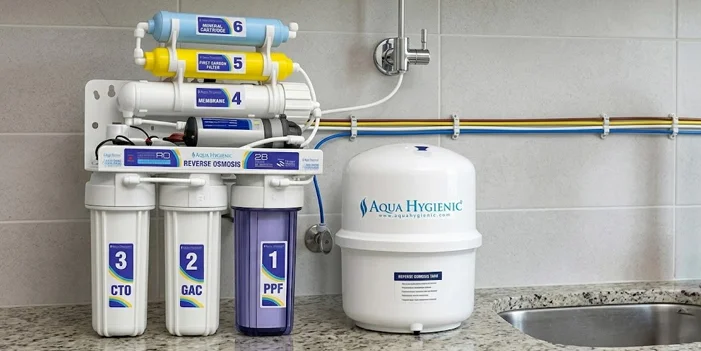
A 100 GPD six-stage home reverse osmosis system designed for household drinking-water treatment.
Delivery and installation: Not included
Optional value-addition stages listed by Aqua Hygienic include:
Additional stages are available at extra cost.
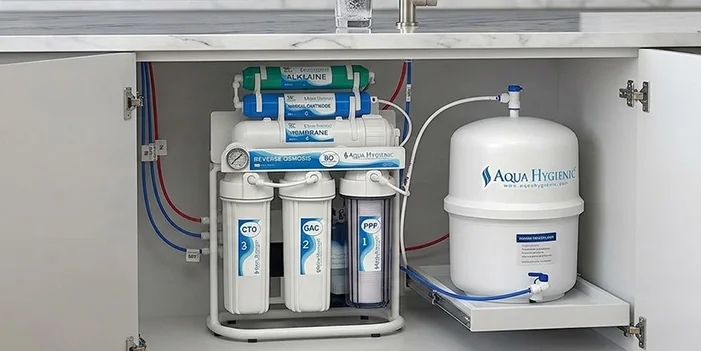
A seven-stage 100 GPD residential RO system for household water purification.
Delivery and installation: Not included
Additional stages listed for this model include Nano Silver, Ultra Filtration, Hydrogen Rich and Ultra Violet, available at extra cost.
For households requiring a higher nominal system capacity, Aqua Hygienic also lists a 200 GPD six-stage Domestic RO.
Delivery and installation: Not included
Optional value additions are available at extra cost.
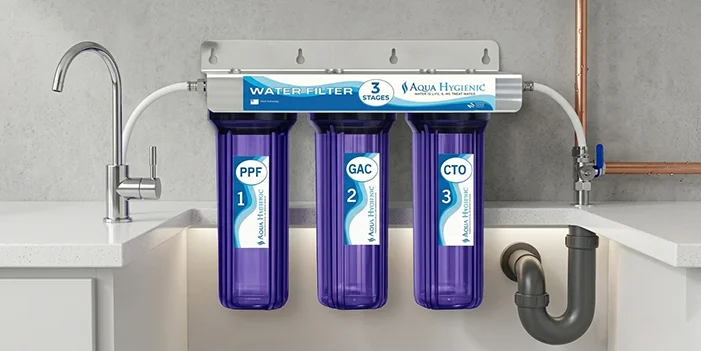
Aqua Hygienic also provides a three-stage water filter for households whose treatment requirements differ from those of a full RO system
Delivery and installation: Not included.
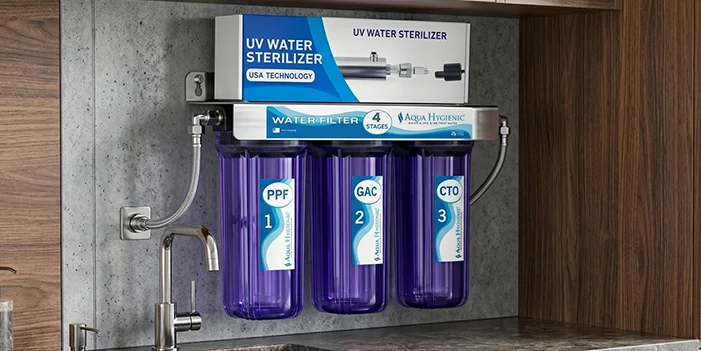
The four-stage water filter adds an ultraviolet lamp to the filtration configuration.
Delivery and installation: Not included.
A RO water purifier for home combines different treatment stages because one filtration method does not address every water-quality issue.
Pre-filtration helps remove suspended particles before water reaches the more sensitive treatment stages. This reduces the particle load reaching downstream components.
Activated carbon is commonly used within drinking-water treatment systems to address chlorine and certain taste and odour concerns, depending on the filter media and water conditions.
The reverse osmosis membrane is the central treatment stage of an RO system. It separates water from many dissolved substances and is therefore used where TDS reduction and dissolved solids removal are treatment objectives.
Depending on the system configuration, additional filtration or treatment may take place after the RO membrane before water reaches the storage and dispensing stage.
The exact filtration sequence should be confirmed for the individual Aqua Hygienic model rather than assuming that every domestic system uses an identical configuration.
A multi-stage water filtration system allows different components to perform different treatment functions.
For example, pre-filtration can address suspended particles, while carbon filtration and the RO membrane perform different roles later in the process. Optional treatment stages may then be added where they are appropriate to the required water quality.
This staged approach is more meaningful than simply comparing systems by the number of filters. What matters is what each stage does and whether it is appropriate for the incoming water.
Aqua Hygienic lists several optional treatment stages that can be added to selected domestic RO configurations at additional cost.
An alkaline stage is offered as an optional addition to selected systems
Nano Silver is another optional stage listed within Aqua Hygienic’s domestic RO range.
An ultrafiltration stage can be added to selected configurations where additional membrane-based filtration is required.
A Hydrogen Rich stage is listed by Aqua Hygienic among the optional value additions available for selected domestic systems.
UV treatment is available as an optional stage on selected RO configurations and is also included with Aqua Hygienic’s listed four-stage water filter.
The suitability of any optional stage should be assessed according to the water condition and treatment objective rather than adding stages solely to increase the filtration-stage count.
The Aqua Hygienic range currently includes both 100 GPD and 200 GPD domestic RO options. GPD means gallons per day and is used as a nominal capacity rating for RO systems.
A higher GPD rating does not automatically mean better water quality. It primarily indicates a different rated production capacity. Actual output can vary with operating conditions, including incoming water pressure, temperature and water characteristics.
For this reason, capacity should be selected according to household demand as well as the conditions under which the system will operate.
Before selecting a domestic RO system, consider more than price or the number of filtration stages.
Incoming water quality: Understand the water being supplied to your home and the problems that actually require treatment.
TDS and dissolved substances: Where reducing dissolved solids is a treatment objective, RO membrane filtration may be appropriate.
Daily water requirements: Consider how much purified drinking and cooking water the household normally uses.
System capacity: Compare the available 100 GPD and 200 GPD configurations according to actual household requirements.
Optional treatment stages: Add supplementary treatment only where it serves a genuine water-quality purpose.
Maintenance: Filter cartridges and RO membranes require periodic replacement. Maintenance frequency depends on the system, incoming water quality, usage and component condition.
This approach helps buyers choose a drinking water filtration system based on practical requirements instead of simply choosing the system with the largest number of stages.
Regular maintenance is an important part of keeping a domestic RO system operating as intended.
Pre-filters, carbon cartridges and RO membranes are consumable components. Their service life can vary according to incoming water quality, usage and operating conditions, so replacement should be based on the condition of the system and applicable servicing recommendations rather than one universal schedule.
Aqua Hygienic separately provides after-sales parts and services, including filtration elements, membranes and other system components.
Water-treatment requirements can vary from one household to another according to source-water quality, TDS, usage and the type of contaminants or water-quality problems present.
A domestic RO system can therefore be considered when a household requires treatment specifically for drinking and cooking water and reverse osmosis filtration is appropriate for the incoming water.
Aqua Hygienic’s current domestic range provides different capacities and filtration configurations, allowing customers to compare systems according to household requirements rather than relying on a single configuration for every home.
Aqua Hygienic provides water-treatment solutions across domestic, commercial and industrial applications. Its current website lists domestic RO systems alongside whole-house filtration, commercial RO plants, industrial RO plants, ultrafiltration and related treatment solutions.
For domestic customers, this means the decision can begin with the actual water requirement: whether the household needs a domestic RO system for drinking water, general filtration, or a broader whole-house treatment solution.
For water treatment across multiple household outlets rather than drinking water alone, see Whole House Water Filtration.
Choosing a home reverse osmosis system should start with your water requirements, not simply the number of filtration stages.
Aqua Hygienic currently offers 100 GPD and 200 GPD Domestic RO options, water-filter configurations and optional treatment stages for different household requirements.
A domestic RO system is a household water-treatment system that uses reverse osmosis membrane filtration along with supporting filtration stages to treat water primarily for drinking and cooking.
An RO membrane acts as a selective barrier within the system. Water passes through the membrane while many dissolved substances are retained, making reverse osmosis useful where reducing dissolved solids is required.
Reverse osmosis is used to reduce dissolved substances and therefore lowers TDS.
GPD means gallons per day and represents nominal RO production capacity. Aqua Hygienic currently lists both 100 GPD and 200 GPD domestic configurations.
Not necessarily. The usefulness of a filtration stage depends on what it is designed to treat and whether that treatment is required for your water. The number of stages alone is not a reliable measure of suitability.
WhatsApp us