- For any information contact us at
- 0321 8447030
- aqua.hygienic@gmail.com

Water Softener vs RO Plant – Which One Do You Actually Need?
We’ve all been there – you get out of the shower and feel like you have a film on your skin or you wake up in the morning and your brand new glass kettle you bought yesterday is covered in white, crusty spots. It’s annoying, and it makes you feel like your house is “dirty” even when you scrub as much as you can.
When you start looking for a solution, you’re usually hit with a wall of technical jargon. “Do I need an RO plant? Should I get a softener? Are they the same thing?”
The short answer is: One saves your pipes and the other saves your health. In this guide, we’re stripping away the sales pitches and have a look at the hard data and the costs, as well as the government standards. Whether you are a homeowner looking to end itchy skin, or a facility manager looking for technical specs, here is everything you need to know to fix your water for good.
Understanding the Core Technologies
Before you pick a system, you need to know the difference between conditioning water and purifying it.
What is a Water Softener?
A water softener is a dedicated filtration system that works to remove high concentrations of calcium and magnesium that cause “hardness.” Using a process called ion exchange, in the system these hardness minerals are exchanged for sodium ions.
· Scope: Typically a Point-of-Entry (POE) system, meaning that it treats all the water entering your home.
What is a Domestic RO Plant?
A Reverse Osmosis (RO) plant is a sophisticated purification system. It pressurizes water through a semi permeable membrane. This membrane has pores so small they block almost everything except water molecules.
· Scope: Typically a Point-of-Use (POU) system that supplies ultra-pure water to one kitchen tap or refrigerator.
Technical Comparison: Softening vs. Purification
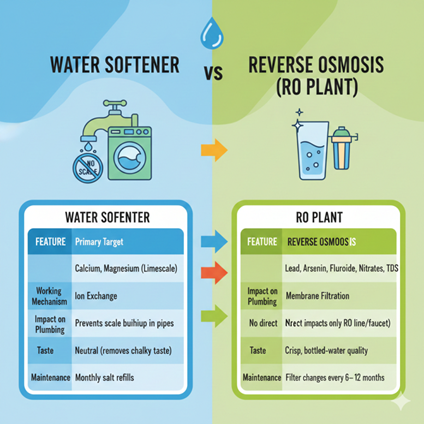
Usage Data: Government and Industry Trends (2025-2026)
Pakistan has seen a dramatic change of landscape in its home water treatment landscape with the growing water scarcity and quality problems in the country. The recent environmental surveys and the PCRWR Water Quality Reports (2025-2026) indicate that:
· Hard Water Prevalence-In Pakistan Approximately 80% of total population now experience severe water shortage at least one-third of the total yearly. The level of ground water in the urban centers such as Lahore, Faisalabad and Karachi are dropping by 0.6 to 0.9 meters every year, therefore raising the levels of mineral concentration and hardness. Whole House Water Softener are, therefore, on a growing path of 9.4 per annum to safeguard against scale damage of domestic plumbing.
· Confidence in Tap Water: A 2025 consumer confidence survey showed that merely 36% of the Pakistanis have access to drinking water which is under safe management. The issue of arsenic (especially in Sindh and Punjab), nitrates due to agricultural runoffs and microbiological contamination have created a huge explosion of Domestic RO Plant sales. The household filtration market (primarily RO technology) will have a high value of more than 800 million dollars in major cities in the year 2026.
· Efficiency & Local Standards: By the end of 2025, provincial water authorities (eg. WASA) and the Ministry of Science and Technology have started to promote high-efficiency RO standards to fight water waste. Although the old, unbranded RO units in Pakistan may consume up to 4 gallons of water to produce one gallon, the newer 2026 compliant industry and domestic versions are using multi-stage recovery technology to minimize wastes, thus more sustainable in the water stressed Pakistan setting.
Which System Do You Actually Need?
Deciding between the two is entirely dependent on your specific water problems.
When to Choose a Water Softener
You should make a water softener your top priority if you notice the “symptoms” of hard water:
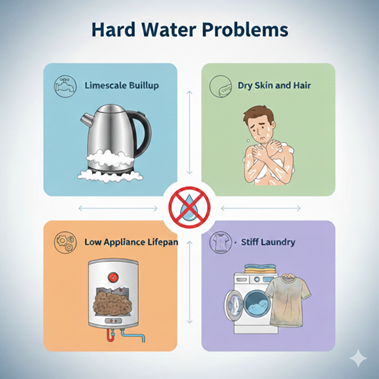
1. Limescale Buildup: White crust on faucets and inside kettles.
2. Dry Skin and Hair: Hard water prevents soap from rinsing away leaving a film on your body.
3. Low Appliance Lifespan: Your water heater or dishwasher fails prematurely due to mineral “rock” forming on heating elements.
4. Stiff Laundry: Clothes feel scratchy and colors fade quickly.
When to Choose an RO Plant
An RO plant is necessary if your concerns are chemical or biological:
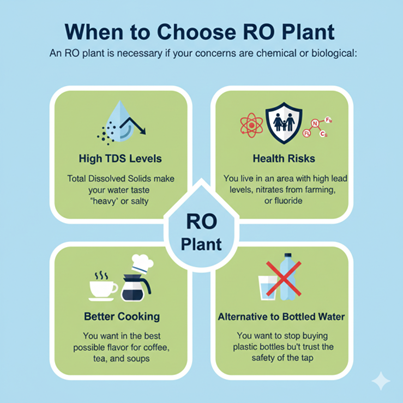
- High TDS Levels: Total Dissolved Solids make your water taste “heavy” or salty.
- Health Risks: You live in an area with high lead levels, nitrates from farming, or fluoride.
- Better Cooking: You want the best possible flavor for coffee, tea, and soups.
- Alternative to Bottled Water: You want to stop buying plastic bottles but don’t trust the safety of the tap.
The Professional Recommendation: The Hybrid Setup
By placing a Water Softener at the main point of entry and an RO Plant at the kitchen sink, you are accomplishing two things Protection: You are protecting your pipes, and the RO membrane itself (Soft water will prevent the membrane from clogging and will prolong its life).Purity: The RO plant serves to provide the last finishing stroke for the water that you are actually ingesting with every use of the RO plant.
Final Decision Matrix:
If your water looks and tastes fine, but it is destroying your appliances, get a Water Softener If your water tastes bad or contains contaminants, but your pipes are clear, get an RO Plant Most of us find that the “Goldilocks” solution is a hybrid: a Whole House Water Softener to protect the home, and an RO to protect the family.
Frequently Asked Questions (FAQs)
A water softener only eliminates minerals that cause water hardness (calcium and magnesium). It does not eliminate bacteria, chemicals or heavy metals such as lead.
Technically yes, but rarely is it recommended for residential use. Whole-house RO systems cost exorbitant amounts of money, waste a lot of water and actually corrode your copper pipes as the water gets “hungry” for minerals.
Yes This is why the hybrid set-up is so popular. The softener introduces a small amount of sodium in the exchange process, and the RO system does a good job of removing the sodium and the low-sodium drinking water that results.
· Water Softener: You will need to put in salt pellets once a month or so.
· RO Plant: You will want to change the pre-filters every 1-2 months and the main RO Membrane every 6 months-1 year.