- For any information contact us at
- 0321 8447030
- aqua.hygienic@gmail.com

Water Filter Plant Price in Pakistan (2026 Guide)
Clean water is no longer guaranteed. Water quality in Pakistan is being altered by rapid industrial development and pollution. Since groundwater in cities like Lahore has high TDS (Total Dissolved Solids) levels,and industrial zones are contaminated with heavy metals, installing a modern purification system is now a necessity.
Whether you are a homeowner or a factory manager, understanding the water filter plant price in Pakistan is the first step toward securing a safe supply. This guide explains the technology, the costs, and the long-term value in simple terms.
What Determines Water Filter Plant price in Pakistan?
A water filter plant is not a universal product. It is an engineered remedy specific to your water chemistry. The water filter plant price in Pakistan fluctuates based on the daily output (capacity) and the technology used to remove undesired contaminants.
Capacity and Output Impact on Water Filter Plant Price in Pakistan
The cost of water purification has shifted due to technological advancements and local economic factors.
| Category | Daily Capacity | Estimated Price (PKR) | Ideal For |
|---|---|---|---|
| Domestic RO Plant | 50 – 100 GPD | 35,000 – 55,000 | Small families, Apartments |
| Light Commercial | 200 – 600 GPD | 60,000 – 120,000 | Offices, Clinics, Cafes |
| Commercial RO Plant | 1,000 – 2,000 LPH | 450,000 – 1,500,000 | Schools, Hospitals, Factories |
| Industrial Plant | 3,000+ LPH | 1,800,000 – 8,000,000+ | Large Industries, Societies |
Note: Final quotations are subject to change based on site-specific water analysis and the prevailing market cost of specialized filter media.
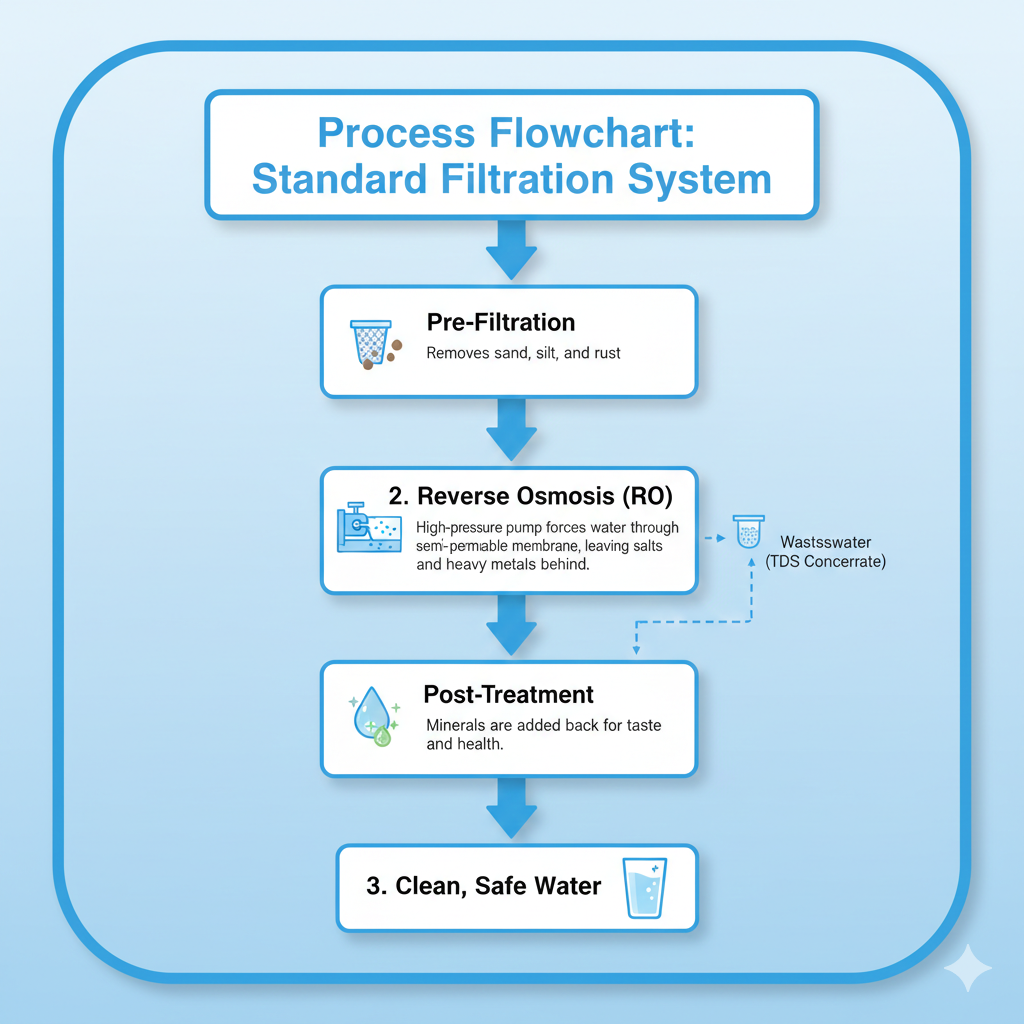
Process Flow Chart: Standard Filtration System
The process is based on mechanical and chemical separation. Water passes through various “beds” or membranes. Each stage targets a specific problem:
- Pre-Filtration: Removes sand, silt, and rust.
- Reverse Osmosis (RO): A high-pressure pump forces water through a semi-permeable membrane, leaving salts and heavy metals behind.
- Post-Treatment: Minerals are added back for taste and health.
Key Factors Affecting the Water Filter Plant Price in Pakistan
Why then is one system more expensive than the other? Originally, the aspect of worth lies in the following three technical areas:
A. Raw Water Quality (The TDS Factor)
The first cost driver is the Total Dissolved Solids (TDS).
- Bore Water (High TDS): It involves the use of high-pressure stainless-steel pumps and special membranes.
- Canal Water: This water requires advanced multi-media pretreatment to avoid clogging.
B. Component Quality & Origin
- Premium: Components from the USA, Japan, or Taiwan (e.g., Dow Filmtec) offer better salt rejection and a longer service life.
- Standard: Assembled locally is cheaper, but parts can be expensive to replace.
C. Commercial vs. Domestic Design
A Commercial RO Plant is built for 24/7 operation and fitted with industrial-grade components, such as Grundfos pumps, which reduce the initial cost to a large extent but increase the cost per litre.
Technology Comparison: Ion Exchange vs. Reverse Osmosis
In the Pakistani market, these two technologies are often used together in a Water Filter Plant.
| Feature | Ion Exchange (Softening) | Reverse Osmosis (RO) |
|---|---|---|
| Main Function | Removes Hardness (Ca/Mg) | Removes Total Salts (TDS) |
| Energy Use | Very Low | High |
| Water Waste | Minimal | High (without recovery) |
| Maintenance | Simple (Salt/Regeneration) | Complex (Membrane Cleaning) |
| Operating Cost | Low | Medium to High |
Benefits of the Modern Plant Installation.
The benefits of the modern systems are practical and tested: this is why they are still popular:
- Mineral Control: Precision removal of arsenic and nitrates.
- Energy Efficiency: 2026 models use 20% less power than older designs.
- Industrial Compliance: A necessity in pharmaceutical and food processing.
- Cost-Effective: It is 70 percent cheaper to make your own clean water as compared to purchasing bottled water.
Limitations and Prevention
No technology is perfect. Water Filter Plant owners should be aware of:
- Fouling: Iron or organic matter can “choke” the system. Prevention: Use activated carbon pretreatment.
- Regeneration: Softeners need salt; RO membranes need chemical washing.
- Microbes: RO does not always kill 100% of bacteria. Prevention: Install a UV Sterilizer.
Maintenance and the Water Filter Plant Price in Pakistan
A common mistake in Pakistan is ignoring the “Annual Maintenance Contract” (AMC). In 2026, the average annual maintenance for a commercial system is roughly 5% to 10% of the initial water filter plant price in Pakistan.
Pro-Tip: A cheap plant with rare, expensive proprietary filters is a “debt,” not an investment. Always ensure spare parts are available in your local city (e.g., Lahore, Karachi).
Summary Checklist for the Best Water Filter Plant Price in Pakistan
- Water Test Report: Never buy without a chemical analysis of your water.
- Warranty: Ensure at least 1 year of coverage for pumps and electronics.
- After-Sales Support: Confirm the vendor has a physical presence in your region.
Final Thoughts
Investing in a water treatment system is an investment in health and industrial efficiency. While the water filter plant price in Pakistan can seem high initially, the long-term savings and reliability make it the most valuable utility for any modern facility.
Frequently Asked Questions (FAQ)
Simple 3-step systems start at PKR 12,000, while a working RO system for salt removal starts at PKR 35,000.
The pre-filters are replaced after every 1-2 months, and the RO membrane may last between 3-6 months, depending on the quality of water.
Yes. You control the quality, the mineral balance, and the hygiene of the process, usually at a fraction of the cost.
Yes, Industrial Plants (3,000+ LPH) will be tailored to large-scale municipal applications and supply to the society population.